A First Glance At Weight-Space Programming for Robotics
We asked frontier LLM agents (Claude Opus 5.5 and GPT-6 Astra) to edit robot policies and build new ones by writing their weights directly, with no gradient descent, no new demonstrations and no simulator in the loop while they work. On small policies, the agents removed learned failure habits and taught a new skill by rewriting a handful of neurons. On π0.5, an edit that touches 2,048 weights raised success on a perturbed LIBERO task. We also found that Astra could construct neural networks from scratch for cart-pole swing-up, cube pushing and peg-in-hole insertion. This is a first glance, with small samples and a limited set of simulated tasks.
What if an LLM could edit a robot policy the way an engineer edits code?
We used two frontier models, Claude Opus 5.5 at maximum reasoning effort and GPT-6 Astra at xhigh reasoning effort, and each one worked alone in a Python sandbox that had numpy but no internet access and no simulator. Every change to the weights had to come from the agent's own reasoning about what the network computes, because gradient descent, fitting the weights to data and any kind of search were not allowed.
We start small, with MLP policies that drive a simulated Franka Panda arm to pick up a 44 mm cube and place it at a target. We plant a weakness or ask for a new behavior, then give the agent the weights, one to five recorded runs and a task description. It cannot run the simulator (only a model of the arm it writes itself) or see the scored starts, and it may edit only the weights into the second hidden layer, which rules out re-mapping inputs or outputs.
A warm-up on small policies
We trained a policy with 1,024 neurons per layer on demonstrations that drop the cube mid-carry whenever it starts on one side of the table. It learned the habit and passed 25 of 50 starts. The agent turned two never-used neurons into a "keep holding" signal and a small path correction, 0.19% of the weights, and the edited policy passed all 50. On a network 16 times larger, two rewritten neurons again fixed every failure, beating the same network fine-tuned on 10 demonstrations.
Removing a learned habit
Agents can also add behavior a network never learned. From one recorded run, an agent rewired 28 neurons that are silent during the pick, so a policy trained only to place the cube now stacks it on another block, although it can no longer do the original placing task. Another moved the drop-off point 100 mm with the input and output layers locked, using five unused neurons.
Teaching new behavior
The agents could also add behavior that a network never learned. Given one recorded run, an agent rewired 28 neurons that are silent during the pick, so a policy trained only to place the cube now stacks it on another block, with the pick unchanged bit for bit. The cost is that the edited policy no longer does the original placing task. Another agent moved the drop-off point 100 mm with the input and output layers locked, by turning five unused neurons into sideways pushes.
Editing π0.5, a 3.35-billion-parameter robot foundation model
We used the public pi05_libero checkpoint of π0.5, which scores in the high 90s on most LIBERO tasks. A 3-billion-parameter vision-language model reads the two camera images and the instruction, and a 300-million-parameter action expert turns that into a 10-step action chunk over 10 flow-matching denoising steps. The robot executes the first 5 steps of each chunk, then replans.
The agent gets
- The action expert's MLP weights
- Human demonstrations of the original task (images, states, actions)
- 60 recorded rollouts of π0.5 on freshly sampled scenes, each labelled with how it failed
- A probe that runs its edit through the full 3.35B-parameter model on 32 to 48 fixed camera frames and returns the actions and every layer's activations, with no limit on calls
- Python with numpy
Not allowed
- A simulator, so it never sees its edit move a robot
- The 50 scored scenes, or any rollout from them
- The vision-language model's weights, the first and last layers, normalization statistics
- Gradient descent, fitting or automated search over weights
- The internet
Can an LLM improve π0.5 on a task it already does fairly well?
- Policy
- π0.5 (pi05_libero) on LIBERO-10 task 8, "put both moka pots on the stove"
- Agent gets
- the action expert's MLP weights, 26 human demonstrations, 60 labelled rollouts on fresh scenes, a probe on 32 frames, Python with numpy
- Not allowed
- the simulator, the 50 scored scenes, the vision-language model, layers 0 and 17, fitting or automated search
- Scoring
- 50 held-out scenes, 3 runs of the edit against 6 runs of the original, then one exact pass of each under repeatable scoring
On LIBERO-10's hardest task, "put both moka pots on the stove", π0.5 succeeds about 58% of the time. The failures have a clear signature. After placing the first pot, the gripper comes down about 2 cm short over the second pot's handle, a finger lands on top of the handle, and the policy hovers there, pressing weakly, until time runs out.
One agent, which we call Handle Nudge, turned four nearly dead neurons in layer 16 into a single gated unit. Its gate fires only during the approach to the second pot, using a signal the network already computes ("the first pot is already placed"), and its output pushes the grasp about 1.4 cm toward the handle.
Averaged over 3 runs of the edit and 6 runs of the original, success rose from 28.8 → 31.7 of 50 (standard error of the gain 1.2, one-sided permutation p = 0.024). Those runs came before we made scoring repeatable, however, and one exact repeatable pass gave 29 of 50 for the edit against 30 for the original, with 9 scenes fixed and 10 broken. We therefore count this gain as unconfirmed.
What happens on a harder task?
- Policy
- π0.5 (pi05_libero), LIBERO-10's microwave task with the mug resized (LIBERO-Pro2.0, perturbation S08)
- Agent gets
- the action expert's MLP weights, 34 demonstrations with the normal mug, 60 labelled rollouts on fresh scenes, a probe on 48 frames, Python with numpy
- Not allowed
- the simulator, the 50 scored scenes, the vision-language model, layers 0 and 17, fitting or automated search
- Scoring
- the 50 standard held-out scenes, one exact run each under repeatable scoring, compared scene by scene
To find room for larger gains, we screened the LIBERO-Pro2.0 perturbations that change an object's shape or size. π0.5 handled most of them well (70 to 90% success). The hardest one whose failures were the robot's own mistakes was LIBERO-10's microwave task with the mug resized to 1.28 times the width and depth and 0.72 times the height. π0.5 solves 34 of the 50 standard held-out scenes.
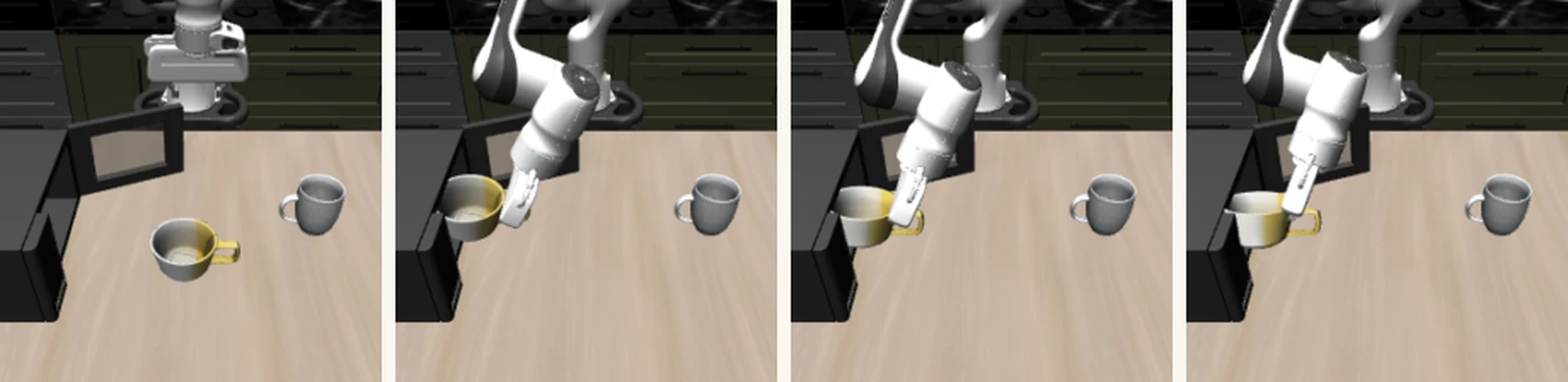
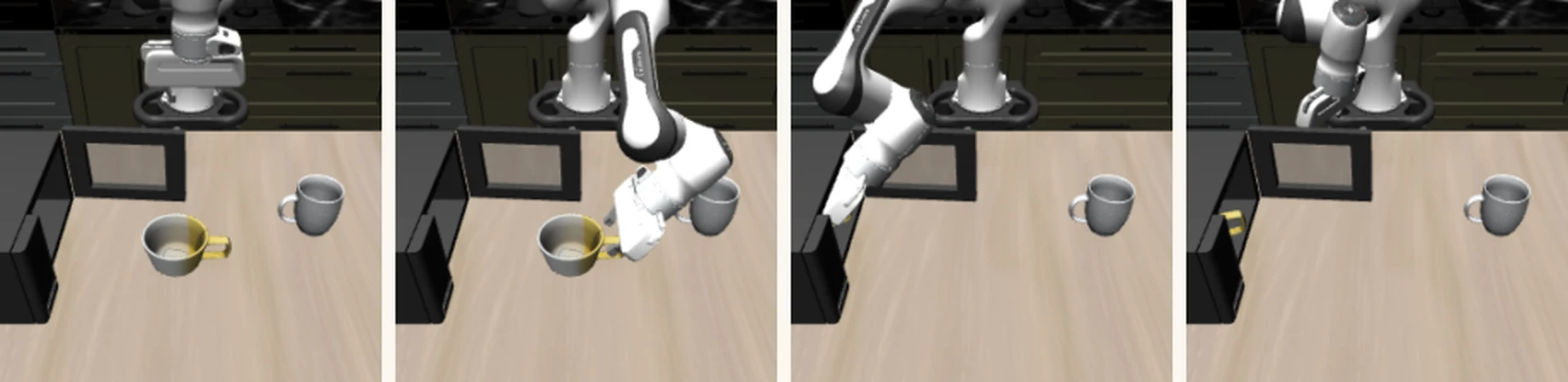
The rollout data points to two problems. π0.5 carries the squat mug about 2 cm higher than the demonstrators carried the normal mug, so its rim catches the top edge of the opening. The higher the mug when it reaches the microwave, the more often the episode fails. And once the mug is stuck, the arm keeps pushing and never lets go. Each action chunk plans the release for steps 6 to 9, but the robot replans after step 4, so a blocked arm replans the same push until time runs out.
Two edits address these problems, and a different agent, working alone, wrote each one. Lower Carry rewires one neuron in layer 16 that fires only while the gripper holds the mug, so that it now also pushes the arm down, and the mug travels about 2 cm lower. Brake Flip targets a neuron in layer 10 that fires when a release is planned but pushes against letting go, a brake that keeps a stuck arm pushing. The edit rewires its 1,024 output weights so the same neuron now pushes toward letting go.
Together, the two edits take π0.5 from 34 → 44 of 50 held-out scenes (68% → 88%) while changing 2,048 of its 3.35 billion weights, about 0.00006% of the model. Brake Flip alone reaches 43 of 50.
| Policy | What changes | Weights changed | Held-out | Fixed | Broken | McNemar p |
|---|---|---|---|---|---|---|
| Original π0.5 | nothing | 0 | 34/50 | n/a | n/a | n/a |
| Lower Carry + Brake Flip | one layer-16 neuron's output, plus one layer-10 neuron's output | 2,048 | 44/50 | 16 | 6 | 0.053 |
| Brake Flip | layer-10 neuron 2491 now pushes toward releasefound by tracing the failing action backward | 1,024 | 43/50 | 13 | 4 | 0.049 |
| Lower Carry (2 neurons) + Brake Flip | two layer-6 neurons built into a carry detector, plus Brake Flip | 7,168 | 41/50 | 11 | 4 | 0.12 |
| Lower Carry | layer-16 neuron 3769 lowers the carry about 2 cm | 1,024 | 39/50 | 8 | 3 | 0.23 |
| Lower Carry (2 neurons) | two layer-6 neurons, the same idea built earlier in the network | 6,144 | 36/50 | 7 | 5 | 0.77 |
How do the agents find these fixes?
We found that the successful agents follow the same steps. They start from the robot's behavior, find a physical quantity that predicts failure, look inside the network for the neurons that carry the relevant phase of the task, rewire one of them, and check on saved camera frames that only the intended frames change.
Started from the idea "correct position errors more strongly", then changed course when the data pointed somewhere else.
- Observerollout data
"Grasp and lift always succeed, so the failures are in the microwave step. I'm checking rollout images to see what happens physically."
- Measurephysics
"Timed-out episodes enter the microwave about 2 cm higher than successes and demos."
It then measured how strongly the policy corrects height on the way in, about 40% of the error, and found the policy aims for the wrong height rather than correcting too weakly. So it dropped its starting idea.
- Decidetarget
"Top-edge catches all came with mug z ≥ 0.989 at y=0.12 ... so lowering the carry about 1.5 cm should clear most failures."
- Look insideactivations
"Unit 3769 in layer 16 is a near-perfect carry-phase gate, firing strongest on the frames where the correction matters."
The neuron is exactly zero before the grasp and after the release, and strongly active whenever the mug is held.
- Rewireone neuron
"I'm adding a −dz component to its layer-16 output row to run the first causal test and measure the effect."
- Testprobe frames
"The first causal test is a clean control. Pre-grasp and post-release frames barely move, while carry frames drop in dz by 0.015 to 0.035."
It tried layers 14 and 15 as well, found the effect weaker or less consistent, blended two directions to cancel a sideways drift, and set the strength to a 2 cm drop.
- Hand offto us
"Expected about 34 → 39 successes out of 50, plausibly anywhere from +0 to +8."
Measured alone, it scored 39 of 50. Its prediction was right on.
Started from the idea "follow the failure back to its source", and spent most of its probe calls ruling out candidates.
- Observerollout data
"Rollout 16 is stuck ... with the mug already in the microwave and the gripper closed for 370 steps."
Each chunk plans the release at steps 6 to 9, but only steps 0 to 4 run before the policy replans, so a blocked arm replans the same chunk and never lets go.
- Look insidedirections
"The MLP reconstructs the weights to 0.24% error ... so per-unit attribution is exact."
It rebuilt the network's MLP in numpy from the probe's activations, then computed a "move on to the release" direction from frames where the release happens.
- Dead endsmany
"Single-unit detectors are too noisy to gate on ... No single unit cleanly separates insertion-phase frames from carry frames."
Pushing that direction everywhere opened stuck grippers but also dropped mugs mid-carry.
- Find the brakeone neuron
"L10 u2491 pushes against the phase direction on every insertion and release frame, acting as a brake."
- Rewireflip its role
"Routing the release through u2491 (k=80) makes frame 31 and carry frames 25, 28, and 35 release now ... while the outside-stuck frames and all demo frames stay unchanged."
- Testdose and size
"Sparsifying the row weakens the effect ... so the full 1024-value row is the minimal edit."
It mapped the dose. Releases appear from k ≈ 65 and overdose artifacts from k ≈ 130, so it chose 85.
- Hand offto us
"Expected effect roughly +2 to +3 successes out of 50."
Measured alone, it scored 43 of 50, a gain of 9. It underestimated its own edit.
Building a neural network from scratch
Can an LLM write a neural network that controls a robot, without training it or testing its behavior? Following the original weight-space programming experiments, we asked Astra to build these policies from scratch for three tasks in simulation.
Astra chose how many layers and neurons each network would have, then used Python to calculate the weights. We froze those numbers before running the network in MuJoCo, a physics simulator. During a run, the network controls the robot; the LLM does not choose its actions. The weights stay fixed while the network reads observations and produces motor commands 50 times a second.
Astra gets
- The task rules and exact physical models
- The network’s input and output layout
- Python with NumPy to calculate and save weights
Not allowed
- Pretrained weights, demonstrations, training or fitting weights to data
- Internet access, a simulator, trajectory emulation or automated search
- Private test cases or a separate controller running alongside the network
- Agent
- GPT-6 Astra (
gpt-6-astra),xhighreasoning, with a fresh session for each task. - Allowed checks
- Static calculations and network checks on independent, made-up inputs; no simulated trajectories before submission.
- Scoring
- 100 randomized test cases per task, kept hidden from Astra, plus 100 harder peg-insertion cases. A pass requires reaching the goal and holding it for one continuous second.
The first networks passed 100 of 100 cart-pole tests, 69 of 100 pushes, and 99 of 100 peg insertions. Astra wrote these weights before receiving any feedback on how they behaved.
| Task | Successes / 100 | 95% interval |
|---|---|---|
| Cart-pole: swing up and balance | 100 | 96.3 to 100.0% |
| Cube pushing: move into the target | 69 | 59.4 to 77.2% |
| Peg insertion: original ranges | 99 | 94.6 to 99.8% |
| Peg insertion: harder ranges | 94 | 87.5 to 97.2% |
These tests use the first submitted weights. The two insertion rows use the same network on independent case sets; both sets of parameter ranges were disclosed to Astra. Intervals are Wilson 95% intervals across the 100 cases in each row.
How does it turn a control rule into weights?
Astra first worked out what each controller should calculate, then wrote Python to express those calculations as network layers. Each layer takes weighted sums of its inputs. Simple nonlinear operations between layers let the network combine different rules, cap a motor command, or approximate a curved function. The saved weights encode the controller Astra designed; they were not learned from experience.
Cart-pole: swing the pole up, then balance it.
Only the cart has a motor; the pole swings freely. The network reads the cart’s position and velocity and the pole’s angle and angular velocity, then chooses a horizontal force. Astra’s rule rocks the cart to build momentum, then balances the pole and brings the cart back toward the center.
Cube pushing: get the whole block inside the target.
The Franka arm receives state values for its joints, the cube and the target, and outputs seven joint torques—the turning forces at its joints. Astra made the network act like a spring pulling the hand toward a point just behind the target center, with sideways corrections to keep the cube on course.
Peg insertion: find the hidden hole by touch.
The arm starts with a square peg already held above the nominal hole location. The actual hole position varies. The network receives recent joint states and wrist force and torque readings, but no camera image or actual hole position.
Astra designed a small spiral search, using the twisting forces sensed at the wrist to steer. As the network estimates that the peg is entering the hole, it reduces the sideways search and continues lowering the peg.
| Hidden parameter | Original ranges | Harder ranges |
|---|---|---|
| Hole offset, each axis | ±4 mm | ±8 mm |
| Clearance per side | 1.5–2.5 mm | 0.75–1.25 mm |
| Sliding friction | 0.2–0.6 | 0.7–1.0 |
Each parameter is sampled independently. The peg and hole have matching orientation, and the arm starts in the same posture. Success requires at least 25 mm of insertion and a one-second hold inside the opening; the full fit, motion and force limits are below.
The same weights passed 94 of 100 cases with smaller openings, higher friction and larger hole offsets. All seven failures across the two test sets exceeded the 30 N contact-force limit.
Can feedback improve the weights?
For pushing, we also tested one revision. Before scoring either version on hidden cases, a fresh Astra session received the original construction code and ten development recordings. The first network passed eight of those runs; in both failures, the cube drifted sideways. Astra could inspect the recordings and do static calculations, but could not train or simulate another run.
Astra strengthened the sideways steering and used the cube’s sideways velocity to compensate for drift. The revised network passed ten new development runs. On the same 100 hidden cases, success rose from 69 to 76: the revision fixed 22 failures but broke 15 successes. We made no further revisions after seeing these final scores.
Network sizes, control laws and exact scoring rules
What runs at evaluation. Each policy is an ordinary feed-forward network of affine layers (weighted sums plus biases) and ReLU operations; cart-pole also uses tanh at its output. The evaluator applies the disclosed input encoding and actuator scaling. The construction code does not run beside the policy.
| Network | Inputs → outputs | Affine layers | Weights + biases |
|---|---|---|---|
| Cart-pole | 5 → 1 | 27 | 145,418 |
| Pushing, first | 29 → 7 | 10 | 299,203 |
| Pushing, revised | 29 → 7 | 10 | 297,930 |
| Peg insertion | 100 → 7 | 62 | 19,818,049 |
Expressing calculations as layers. A ReLU returns its input when positive and zero otherwise. Combining affine layers and ReLUs implements clipping and absolute values exactly and approximates curved functions with straight-line segments. Multiplication can be expressed as ab = ((a+b)² − (a−b)²) / 4, with the squares approximated this way. For the arm, Astra also received static information about hand motion and gravity support at the starting posture.
All tasks use 2 ms physics steps and 20 ms control intervals. Success is checked at every physics step. The time limit is 15 seconds for cart-pole and pushing, and 30 seconds for insertion. Each task requires a continuous one-second hold.
Cart-pole setup and scoring. A 1 kg cart carries a freely hinged 0.1 kg, 1 m pole. Only the cart is actuated, up to ±10 N. The pole starts near hanging down. Success requires at most 10 degrees from upright and 0.5 rad/s angular speed, with the cart within 25 cm of center at no more than 0.25 m/s, continuously for one second. Crossing ±2.4 m fails immediately.
Cart-pole. With cart position x, velocity v, pole angle q measured from downward and angular speed w, the energy term is E = w²/60 + 0.4905(1 − cos q). The upright value is 0.981 J, and Astra chose a 1.12 J pumping target to allow for losses. Its local acceleration law is approximately a = 2.08245x + 4.12319v − 38.87627δ − 9.74879w, with δ the upright angle error. The force map is F = (1.1 − 0.075c²)a + 0.05v − 0.73575cs − 0.015cw − 0.05sw², where s = sin q and c = cos q. Rail-related acceleration limits and a bounded final tanh output are inside the network. Initial x and q are independently uniform in ±0.1 m and ±0.1 rad, and both velocities are independently uniform in ±0.05 in their respective units.
Pushing setup and scoring. The 5 cm, 80 g cube starts 5.5–8.5 cm ahead of the home hand position; the 13 cm-wide square target’s center is 14–18 cm ahead. Cube and target independently vary by ±1.5 cm sideways. The arm starts in the same posture. The entire rotated cube footprint must remain inside the target while touching the table for one second.
Franka. Forward stiffness is 220 N/m, capped at ±4 N. Vertical stiffness is 800 N/m, and pitch stiffness is 35 Nm/rad. Gravity and hand-position formulas use the planar joint model with a first-order gravity correction for departures from that plane. In the revision, sideways reference is clip(cy + clip(0.5(cy − gy), ±0.015) + clip(0.43910vy, ±0.020), ±0.080), in meters relative to the home hand position. Here cy and gy are cube and target positions, and vy is cube velocity. Seven outputs are scaled by torque limits [87, 87, 87, 87, 12, 12, 12] Nm. Fingers are fixed. Cube yaw is uniform over a full turn, and all stated position samples are independent.
Peg insertion. The peg is 20 mm square, 60 mm long and 50 g, fixed to the gripper above an unchamfered 40 mm-deep hole. Each of five frames contains q − home, q̇/3, wrist force divided by 20 N, and wrist torque divided by 2 Nm: 20 values per frame, newest first, spanning 80 ms. The sensor includes payload gravity and inertia. The network analytically approximates geometry, gravity and Jacobians around home, then maps a designed wrench to joint torque internally. Success requires 25–40.5 mm tip depth, the full horizontal peg projection fitting the opening, tilt ≤3°, tip speed ≤0.020 m/s, angular speed ≤0.10 rad/s, and penetration ≤1 mm for a full second. Penetration above 2 mm also fails. The force guard sums contact-force norms across the robot and fixture/support, so opposing forces cannot cancel. The wrist sensor measures only the peg payload. The vertical equilibrium is 32 mm deep. A combination of joint angles acts as the search-progress signal, so the network uses the arm’s motion rather than an external clock. Search fades as estimated entry begins; no captured hole center or external recurrent state is provided.
Development and final scoring. Cart-pole and peg insertion each passed all ten initial development runs and were not revised. Pushing used ten runs before its single revision and ten new runs afterward, within the available budget of 100 development runs per task. Development ended before any hidden-case outcomes were revealed. Both pushing versions were then scored on the same 100 cases: 54 passed with both, nine failed with both, 22 were fixed and 15 were broken by the revision. The revised network’s 76/100 success interval is 66.8–83.3% (Wilson 95%). The two development batches used different starts and are not a paired comparison.
These results show that Astra can construct working controllers and express them as neural weights for these simulated tasks. It was given the physical models and parameter ranges. Pushing uses a small workspace and a generous target; insertion begins with an already grasped, correctly oriented peg. We have not tested new robot geometry, noisy sensors, camera input or real hardware, and one authoring run per task does not establish reliable construction for arbitrary tasks.
Code, weights and sandbox audit
Was the author offline? Its tools had no internet access. Every Python call ran under an OS sandbox denying networking and reads of private evaluator files or unrelated policies. The trusted host still contacted the remote model service for inference. This was not an air-gapped machine, and it did not remove internet-derived pretraining knowledge.
Evidence files include per-case results and artifact hashes, original construction source, cart-pole construction, pushing revision, and isolation audit.
Peg-in-hole evidence includes all final outcomes, numeric weights, exact prompt, submitted control-law explanation and plotted trace.
Takeaways on how LLMs approach a policy's weights
From this first look, LLM agents do not treat weights as a black box to be searched.
- We found that every successful agent starts from behavior, not weights, and finds a physical cause in the rollout data, such as entry height or a release planned too late in the chunk, before it opens the network.
- We found that the agents trace neuron activations for a specific action. They record activations at many layers on fixed frames, find the neurons or directions that light up during one phase of the task, and confirm the link by injecting a small change and watching which frames respond.
- We found that the agents prefer surgical, gated edits that act only where the failure happens. Instead of nudging many weights, they repurpose a nearly unused neuron or flip the role of one that is already wired to the right phase.
- We found that the agents measure where in the network an edit lasts and choose layers accordingly. A push written at layer 16 is partly undone by the later denoising steps, while the same push at layers 6 to 10 lasts.
Request an evaluation
Want to see how your robot policy holds up? Tell us about it, and we’ll be in touch shortly.
Thanks, request received.
We’ll be in touch shortly.